
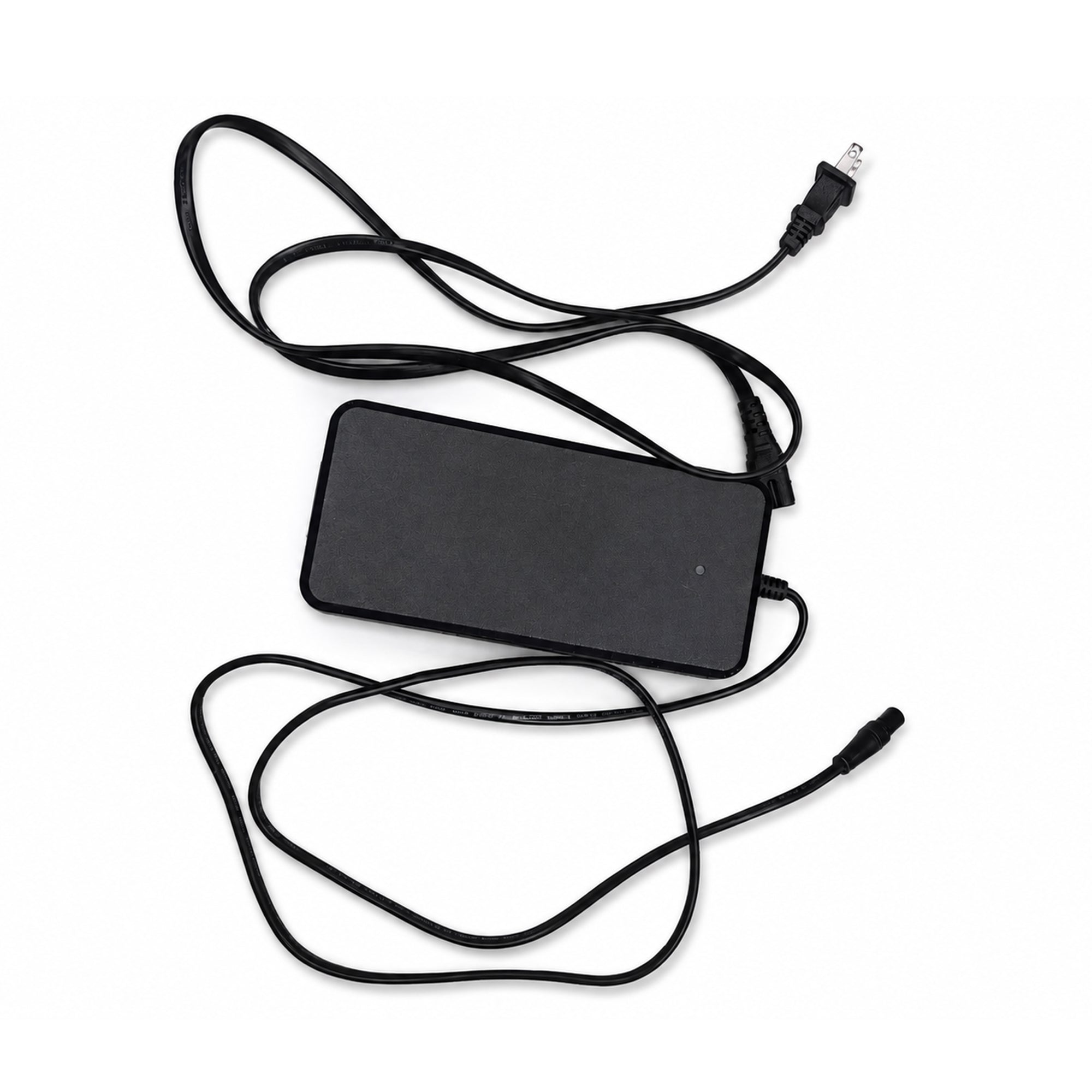
Electric bike chargers are not universal. Two chargers can use similar-looking connectors while delivering different voltage, current, polarity, communication, or charging behavior. Using the wrong charger can damage the battery or create a serious fire risk.
Why a matching plug proves very little
The connector is only one part of compatibility. The replacement must match the exact battery and charging-system requirements, including:
- Battery chemistry and nominal voltage.
- Required charger output voltage.
- Permitted charging current.
- Connector dimensions and pin layout.
- Polarity.
- Battery-management or communication requirements.
- Model and battery revision.
A charger described as “universal” may include interchangeable plugs without correctly matching the electrical system. Do not rely on the physical fit.
Use the original or an explicitly approved replacement
The safest approach is to use the charger supplied with the e-bike. When replacement is necessary, identify the exact bike model, battery model, voltage, connector, and revision. Purchase a charger listed as compatible by the manufacturer or seller for that exact configuration.
Do not substitute a charger merely because its advertised wattage appears close. A higher or lower output can still be unsuitable.
Check the labels
Compare the information on the original charger, battery, manual, and replacement listing. Never alter a plug, reverse wiring, use an improvised adapter, or bypass a safety feature to make a charger connect.
If the original label is unreadable or the battery identity is uncertain, contact support before charging.
Charging safety routine
- Inspect the cable, plug, case, and charging port before use.
- Charge in a dry, ventilated area on a stable, non-combustible surface.
- Keep the bike away from exits and combustible materials.
- Remain present and disconnect according to the manual.
- Do not cover the charger or use it where heat cannot escape.
- Do not charge immediately after water exposure or when the battery is extremely hot or cold.
Stop charging immediately when
- The charger or battery becomes unusually hot.
- You notice swelling, smoke, hissing, leakage, sparks, or a strong chemical odor.
- The connector is loose, discolored, melted, or repeatedly interrupts charging.
- The battery was recently crushed, punctured, submerged, or severely impacted.
Do not throw a lithium battery into household trash or ordinary recycling. Follow local hazardous-battery handling instructions.
Buying a replacement from this store
Search by the exact model name, then compare the product listing with the battery and original charger labels. Some models have multiple revisions, so the model family alone may not be enough.
Browse Batteries & Chargers. When uncertain, contact support with the order number, full model name, battery-label photograph, and charger-port photograph before ordering.
Teilen:
Electric Scooters for Kids: Age and Safety Guide